
If you were told that your project would only experience 1% curtailment, that, to most people would be a clear green light to push ahead with development.
But what if that 1% curtailment could cost over 10% of your project's total revenue?
I've been spending a lot of time in GridScout lately, pulling apart what's actually happening to projects connected between Bannaby and Yass. The numbers tell a really interesting story, and I think understanding it properly gives anyone in this space a genuine edge, whether you're developing, investing, or financing.
The million dollar question
There's a common assumption that low curtailment means low project impact. But the data shows something quite different. The wind farms connected on the 330kV lines between Bannaby and Yass are connected to what would be considered a typical, strong connection point; large 330kV lines, ample headroom and close to the load centre.
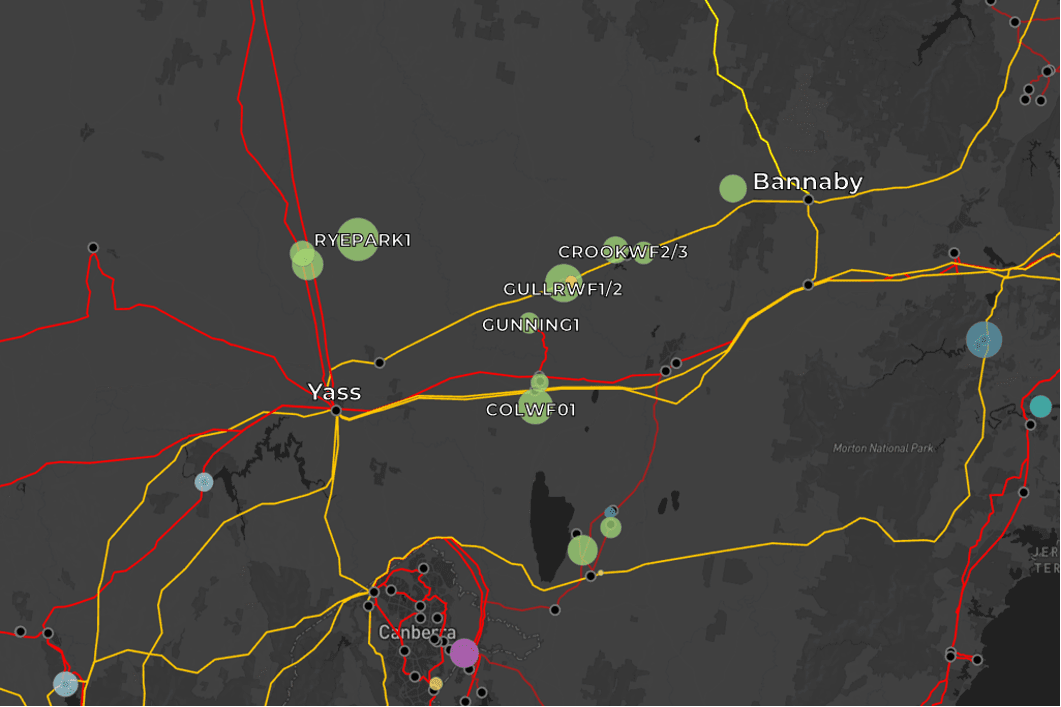
This network strength is clear in the network curtailment numbers for the projects, ranging between 1-2% of total availability. However, when looking deeper, we see that the 1-2% technical curtailment can lead to 13% revenue losses. All of a sudden, low curtailment doesn't look so attractive.
| DUID | Merchant Revenue | Curtailment Rev. Loss | Curtailment (%) | Rev. Loss (%) |
|---|---|---|---|---|
| CROOKWF3 | $12.03m | $1.83m | 1.4% | 13% |
| CROOKWF2 | $19.16m | $2.46m | 2.1% | 11% |
| COLWF01 | $38.53m | $4.39m | 1.4% | 10% |
| GULLRWF2 | $27.49m | $2.81m | 1.6% | 9% |
| GULLRWF1 | $33.11m | $3.07m | 1.3% | 8% |
| RYEPARK1 | $89.21m | $7.73m | 1.1% | 8% |
| GUNNING1 | $12.20m | $0.37m | 0.4% | 3% |
From system normal to system never
Let's look a bit deeper to understand what's really going on. Below is a chart of network curtailment for all wind farms connected between Bannaby and Yass, overlaid against the NSW wholesale price across a typical day.
The correlation is hard to miss. Curtailment is greatest when prices are highest. This is one clear signature of network-driven curtailment; units behind the constraint get wound back at exactly the moment the market is paying the most for their output.
So what's behind it? Looking at the most impacted unit, CROOKWF3, the curtailment isn't coming from a single constraint binding consistently across the year. Instead, large volumes are concentrated in specific months, tied to specific network outages.
Of the 40 constraints that drove CROOKWF3's curtailment in 2025, around 32 are network outage constraints. Perhaps more importantly, the outage constraints often coincide with higher curtailment as well as much higher market prices than system normal or NIL constraints. This type of pattern is experienced by all the units connected between Bannaby and Yass. This goes to show the importance of understanding that the network isn't static, but can change drastically under different network configurations.
Where power systems meets markets
So why are these particular units so exposed? It comes down to where they sit in the network.
Looking at the most impactful constraint, N::N_CNLT_2 represents the stability limit (Snowy–NSW) for fault of various locations between Yass–South Morang area, given the network outage of Lower Tumut to Canberra (07).
Looking at the constraint coefficients, Crookwell 2 and Crookwell 3 sit at 1.0, followed by the other wind farms between Bannaby and Yass and then the batteries in Canberra. These are the units at the edge of the cutset — the first to be constrained off when outage constraints bind.
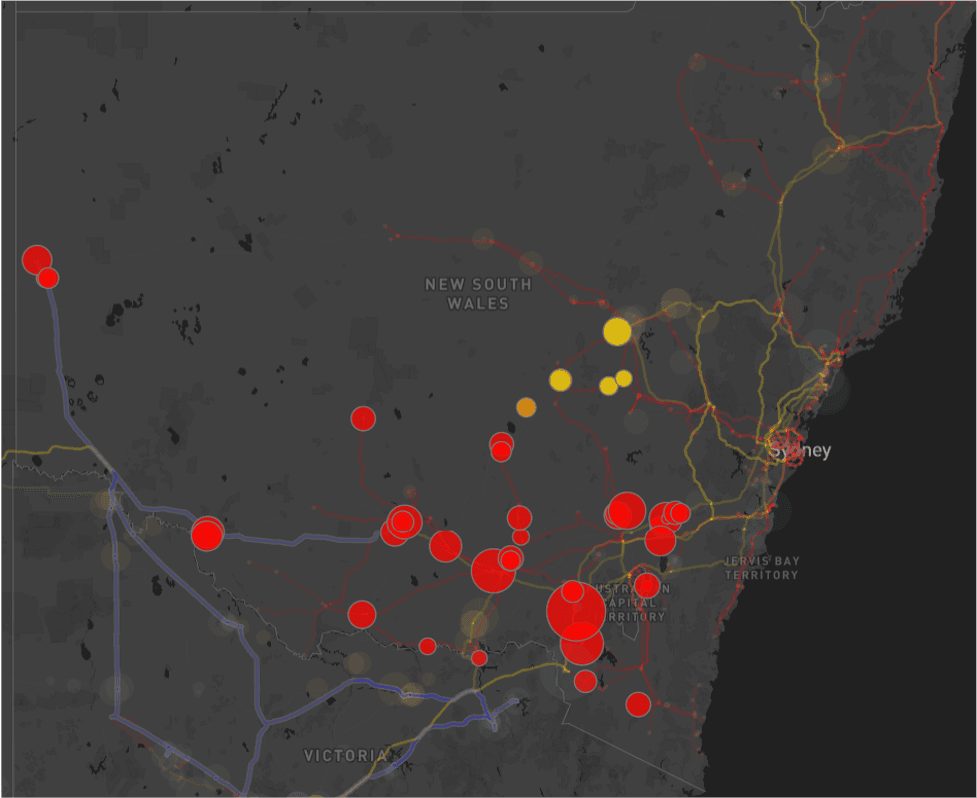
This part of the network (Bannaby to Yass) is incredibly sensitive to outages. A single 330kV line out of service is enough to drop the transfer limit and push these units into curtailment. Under system normal conditions the corridor has ample headroom and these look like excellent connection points. But the network is rarely in a textbook state for the entire year, and the hours it isn't are disproportionately the hours that matter most for merchant revenue.
What this means for development and financing decisions
The important nuance is that not all of these units are feeling this revenue pain equally, as most aren't fully exposed to the spot market. A number of these projects have offtake agreements in place that effectively insulate them from the tail risk. And that's a smart structure for a grid position like this. If your connection point can't reliably capture the price tail, locking in a fixed offtake price means the asymmetry between curtailment volume and revenue impact largely becomes someone else's problem. In locations where tail capture is structurally unreliable, a well-priced offtake moves from being just a risk management tool, to arguably the right commercial strategy.
For new developments, curtailment analysis gives you a much clearer picture of what a connection point is actually worth on a merchant basis. The questions that separate a connection point that looks good from one that actually is:
- When is the relationship between the binding constraints and market prices?
- When do I get curtailed?
- How often do key transmission elements go out of service?
- What does the curtailment profile look like under outage conditions versus system normal?
And what about battery curtailment?
If network-driven curtailment disproportionately wipes out high-value hours for units connected between Bannaby and Yass, think about what that means for a battery sitting behind the same constraints. A significant portion of the battery business case is built on capturing price spread in exactly those volatile, high-value windows; the same windows that disappear the moment a constraint binds the corridor.
Merchant exposure for a battery in a congested location isn't just suboptimal, it's potentially fatal.
A tolling agreement might seem like a way to manage this, but from the offtaker's side it's worth thinking carefully about what risk you're actually absorbing. If the battery can't access high price tails caused by network outages, a tolling structure effectively transfers that missing value capture risk onto the offtaker. For the offtaker, whether that's a price worth paying depends entirely on how well you understand the congestion dynamics at the connection point. I'll be digging deeper into battery curtailment trends and what they mean for storage economics in an upcoming article.
The bottom line
Ultimately, whether the Bannaby to Yass corridor is a good connection point or not isn't a simple yes or no; it depends on your merchant exposure to the spot market. For a fully contracted project with a well-priced offtake, 1-2% network curtailment is an excellent position to be in. For a project carrying significant merchant tail risk, that same 1-2% curtailment can quietly erode 10%+ of your revenue.
This all goes to show that choosing a connection point is no longer a box-ticking exercise. Rather, it's the first operating decision you'll ever make, and the one you'll live with the longest. It's worth getting right.